Christ is Worth More
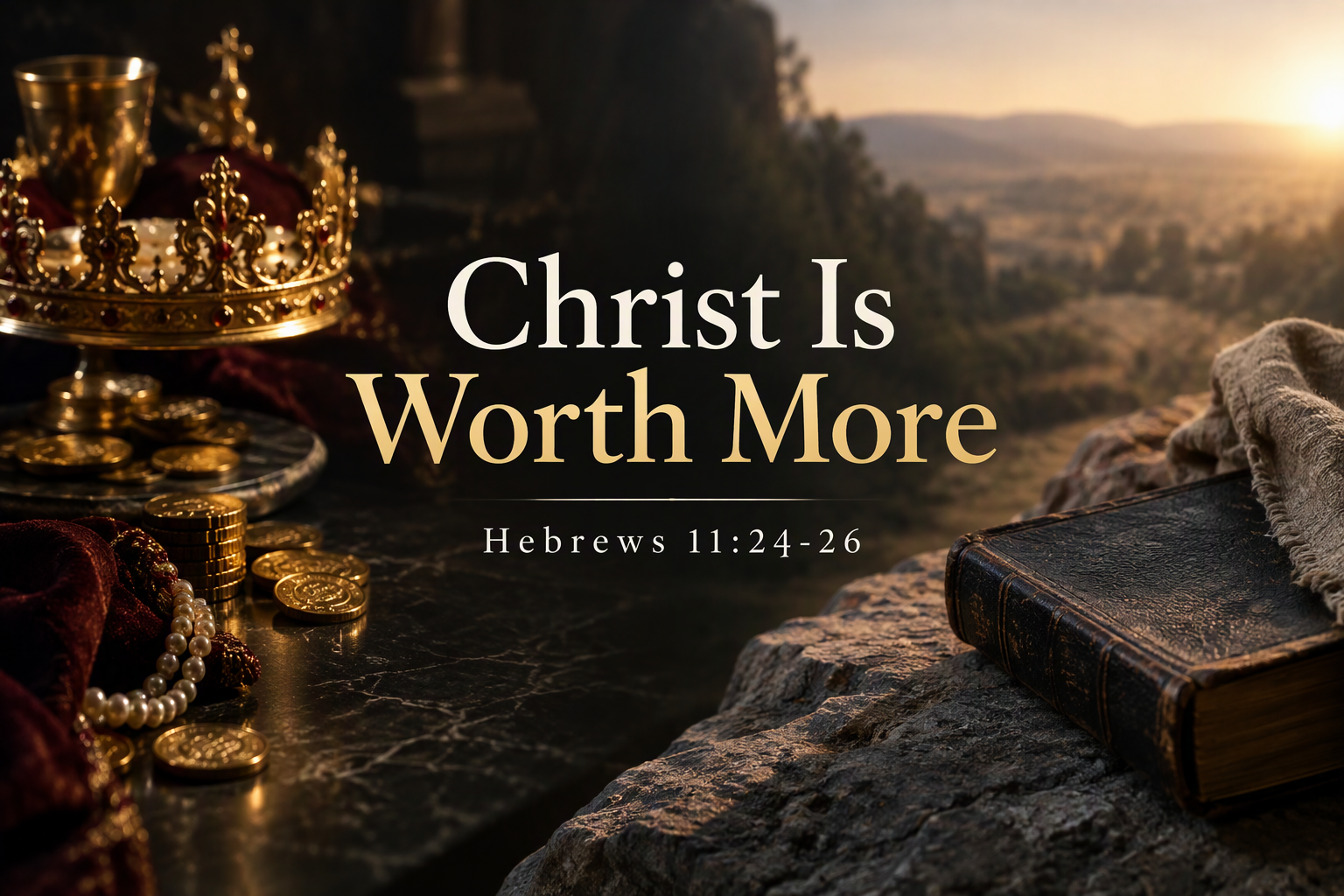
Hebrews 11:24-26:
“By faith Moses, when he was grown up, refused to be called the son of Pharaoh's daughter, choosing rather to be mistreated with the people of God than to enjoy the fleeting pleasures of sin. He considered the reproach of Christ greater wealth than the treasures of Egypt, for he was looking to the reward.”
A Culture That Profits From Our Appetites
Watch a video for a moment, and an ad is already waiting, crafted for your age, your sex, your interests, your habits, and even the weaknesses that often accompany them. For one person, it is a body carefully displayed to stir lust. For another, it is a promise of comfort, status, wealth, or security. A new gadget. A nicer car. A better life that always seems to sit just beyond the next purchase. None of it appears by accident. Every image, every promise, every temptation is strategically placed.
Now, this kind of targeting is not always harmful. If you enjoy woodworking, fishing, or a particular trade, it can be genuinely helpful to discover a useful tool, a good book, or supplies suited to your craft. Purchasing something useful is not a sin in itself. In fact, I regularly come across books, theological resources, ministry tools, and conferences that are genuinely useful, and I might never have discovered some of them otherwise.
But the same algorithms that learn what we enjoy learn something else as well. They sort us into demographics and quietly ask a colder question: What temptation is this person most likely to indulge? What weakness are they most likely to feed?
Then the answer is placed directly in front of us.
For some, it is lust. Young men, especially, are relentlessly targeted on platforms like YouTube and social media. For others, it may be covetousness, greed, envy, vanity, anger, or endless self-indulgence. No one is outside the net. The system studies our desires, identifies our vulnerabilities, and presents them back to us in the form of carefully crafted temptations.
Put plainly, companies sift through the inclinations of our fallen hearts and look for the sins most likely to capture our attention. Then they package those desires, place them on the shelf, and profit every time we take the bait. That should strike us as something deeply shameful. Human weakness has been turned into a business model. What God calls a struggle to be mortified, the world treats as a market to be cultivated.
This is not meant to condemn those who are already in the fight. The very fact that there is a struggle is often evidence that the Spirit is at work, teaching us to wage war against the flesh. It is meant to ask where we turn when the pull comes. The Bible's first answer is not "try harder." It is to "look at what is actually worth more." Moses is a good teacher here, because he stood before an offer far bigger than anything on our screens, and he said no.
Moses Saw Something Worth More
Consider what Moses had in front of him. He was, by upbringing, the son of Pharaoh's daughter, a prince in Egypt. That meant comfort, education, honor and access to the treasures of the greatest power of his day. The author of Hebrews is illuminating the temptations silently tempting Moses in the pages of Exodus.
Yet Hebrews tells us that Moses “refused to be called the son of Pharaoh's daughter.” Notice the verbs in our passage: he refused, he chose, and he considered. This was no rash decision made in the heat of the moment.
On one side stood "the fleeting pleasures of sin" and "the treasures of Egypt." The author does not pretend these pleasures were imaginary or insignificant. They were real. Egypt offered wealth, privilege, comfort, status, and every earthly advantage that would appeal to Moses’ flesh. Yet they shared a fatal weakness: their pleasures were seasonable and their glory was passing away.
On the other side was something that looked like a loss: being "mistreated with the people of God," bearing "the reproach of Christ." By any ordinary measure, it was the poorer choice. Yet Moses "considered the reproach of Christ greater wealth than the treasures of Egypt." In his accounting, disgrace with Christ outweighed the riches of Egypt.
Why? The text gives the reason in a few words: "for he was looking to the reward." Moses was not mainly fighting temptation by gritting his teeth. He was looking at something. His eyes were fixed on a reward that made Egypt's best offer look small.
Notice what this means for the struggle with lust and covetousness. For Moses, there was no pull of lust or covetousness that won out, because Christ was worth more. The desire did not have to be overpowered at the last second. It had already been outweighed, because he had judged rightly what was valuable.
That is where our struggle begins too. Sin is always selling something. It points to a pleasure, a possession, a desire, or an opportunity and whispers, "This is what you need. This is what will satisfy you." But its promises have an expiration date. Faith looks beyond the glitter of the moment and remembers what Moses saw: the true treasure is not found in the passing pleasures of sin, but in Christ Himself.
Christ Is Worth More
Moses is not alone in this judgment. Two other voices in Scripture say the same thing.
The first is the Apostle Paul. If anyone had a résumé to be proud of, it was Paul. He had the right ancestry, the right upbringing and the right moral record, even circumcised on the eighth day. Yet he writes in Philippians:
"But whatever gain I had, I counted as loss for the sake of Christ. Indeed, I count everything as loss because of the surpassing worth of knowing Christ Jesus my Lord. For his sake I have suffered the loss of all things and count them as rubbish, in order that I may gain Christ." (Philippians 3:7-8)
Paul does much what Moses did. He gathers up everything the world would count as gain and places it on one side of the scales. Then he places Christ on the other. The comparison is not even close. His pedigree, his achievements, his zeal, and all the righteousness he thought he had accumulated through his own efforts become rubbish next to the surpassing worth of knowing Christ. He is not simply giving up bad things. He is surrendering even the good things he once treated as treasure because he has found something infinitely better.
The second voice is Jesus himself, in a short parable:
"The kingdom of heaven is like treasure hidden in a field, which a man found and covered up. Then in his joy he goes and sells all that he has and buys that field." (Matthew 13:44)
Picture the man. He has possessions, plans and a measure of security. Then he sees the treasure, and everything else on his ledger shrinks. He sells all that he has. Then, I want us to take careful note of the words "in his joy." Nobody is coercing him to sell. He sells gladly, because he has seen something worth more than all he owns. The treasure is Christ and his kingdom.
Moses, Paul and the man in the field all make the same judgment. They weighed Christ against everything the world could offer, and Christ was worth more. None of them was pretending this world's offerings were not alluring. They simply saw that those things could not compare to the immeasurable worth of Christ.
So here is the resolve I would urge on you, and on myself. When we are struggling with sin, let our heart's resolve be to say: Christ is worth more.
Christ is worth more than the alluring images that seek to captivate our lust!
Christ is worth more than the endless stream of voices competing for our attention, shaping our desires, and telling us what will make us happy!
Christ is worth more than the ambitions, possessions, and comforts for which we are tempted to devote our lives!
This is not a magic phrase. It is a truth to be believed, and the Spirit uses truth to loosen sin's grip. When the image appears, or the ad, or the quiet wanting that says "if only I had that," we can answer it with a judgment as old as Moses: you are not the treasure. Christ is my treasure.
If you are reading this and are not sure that you know Christ, the invitation is the same one Jesus gave long ago: come and see the treasure. Men and women from every age, station, and circumstance have counted Him worth more than everything else and found that they were not disappointed. The invitation still stands.
And if you have stumbled, as every one of us does, the gospel does not send you away. The One who is worth more than all things gave Himself for sinners. He knew every failure He was purchasing when He went to the cross, and He still receives all who come to Him by faith.
One question to carry with you: the next time something on a screen pulls at you,
what will you say is worth more?
With love in Christ,
Pastor Chris
Subscribe to my email list
Subscribe to receive weekly devotions, theological reflections, and resources that deepen your walk with Christ.
Thank you for subscribing!
Have a great day!