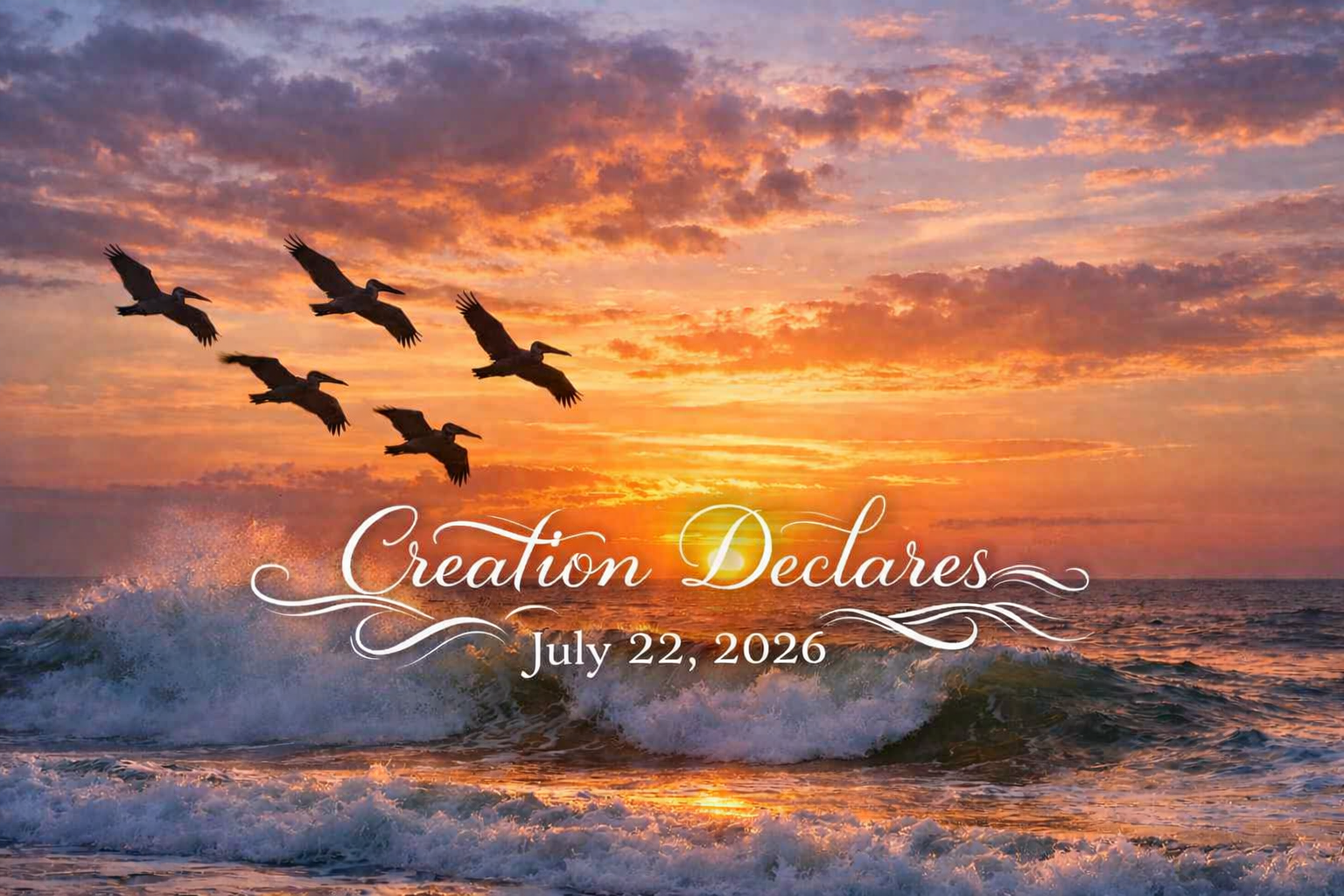
Creation Declares
Romans 1:19-20
For what can be known about God is plain to them, because God has shown it to them. For his invisible attributes, namely, his eternal power and divine nature, have been clearly perceived, ever since the creation of the world, in the things that have been made. So they are without excuse.
I am writing to you this week from our campsite in Crescent City, California. Every summer, our family makes this same pilgrimage north to our property that’s nestled between Lake Talawa and the Pacific Ocean. I currently sit amongst a small city of trailers, tents, and RVs lined up about a hundred yards from the Pacific Ocean. It's a bit chaotic, if I'm honest. But it’s also one of my favorite weeks of the year, and after missing a few summers, being here again carries renewed sense amazement.
Yesterday evening I walked down to the shoreline with my wife to watch the sun sink into the horizon. The whole scene was washed in a soft blend of blue, purple, and scarlet. The ocean here doesn’t whisper—it roars. Each wave hurls itself against the shore with relentless authority, and I’m left in awe at the sheer volume of water endlessly crashing forward, again and again, as if commanded by something greater.
Out past the breakers, a couple seals bob in the swells, curious and unhurried. Overhead, seagulls and pelicans sweep across the sky, scouting the schools of fish churning in the waves. And sometimes, if you’re fortunate, you might see the dark arc of a whale’s back rise a half mile offshore, followed by the soft plume of its breath lingering in the air before the wind gathers it up and carries it away.
When I’m not bent over piles of gravel searching for agates, I like to simply stand there doing nothing but watching. The words of the 1917 hymn by Frederick M. Lehman are often on my mind, if not sung from my lips, as I look out across the scenery.
Could we with ink the ocean fill
and were the skies of parchment made,
were every stalk on earth a quill
and every man a scribe by trade,
to write the love of God above
would drain the ocean dry;
nor could the scroll contain the whole,
though stretched from sky to sky.
O love of God, how rich and pure!
How measureless and strong!
It shall forevermore endure:
the saints’ and angels’ song!
And I find myself thinking, "Someone powerful made this." The scene I see is not by mere accident. Matter could not simply arrange itself into whales and gulls and thunderous water. Someone with staggering imagination and confounding power stands behind all of it. Scripture declares that God is, “Mightier than the thunders of many waters, mightier than the waves of the sea, the LORD on high is mighty!” (Psalm 93:4) And that, “Whatever the LORD pleases, he does, in heaven and on earth, in the seas and all deeps.” (Psalm 135:6) That feeling, that instinct that rises up in us on a beach, or under a night sky, or at the rim of a canyon—Scripture tells us that feeling is, in fact, exactly the response God designed creation to produce in us.
Creation's Testimony
Paul writes in Romans 1:19-20, "For what can be known about God is plain to them, because God has shown it to them. For his invisible attributes, namely, his eternal power and divine nature, have been clearly perceived, ever since the creation of the world, in the things that have been made."
Notice what Paul is claiming here. He's not saying creation offers a few subtle hints about God, a faint clue that a clever philosopher might eventually piece together after years of careful reasoning. He says God's attributes have been "clearly perceived." The Greek word behind that phrase carries the sense of something seen with the mind through the things that are visible—it's the language of intellectual perception, not mere emotional impression. Creation is a text. It is a testimony. It has content, and that content is God Himself—specifically, His eternal power and His divine nature. This is why theologians have long spoken of "general revelation"—the truth that God has revealed something real and true about Himself in the created order itself, available to every person, everywhere, at every point in history, whether or not they ever hold a Bible in their hands.
The whale breaching off the coast of Crescent City is not neutral information. It is a sermon preached in salt water, and its content is: there is a Maker, and He is immense. That is why Paul can say, in the second half of verse 20, that people are "without excuse." Not because everyone reasons their way to correct theology from a sunset—but because the evidence is not hidden. It is not obscure. It is, Paul insists, plain. The problem has never been a shortage of evidence.
The problem, as Paul goes on to describe later in the chapter, is a heart that would rather worship the creature than the Creator. But today, I don't want us to dwell on the excuse-lessness of unbelief nearly so much as I want us to recover the wonder that Paul assumes is the natural, appropriate response to this evidence. Before Romans 1 becomes an argument about human guilt, it is first an observation about divine glory. God has filled the world with things that declare Him. And He has given us eyes, minds, and yes—hearts capable of awe—to receive that declaration.
The Depths That Declare Him
If Romans 1 tells us that creation reveals God's power, the book of Job shows us just how far beyond our comprehension that power actually is—especially, fittingly enough, the power on display in the sea. In Job 38, after Job has spent thirty-seven chapters demanding an explanation from God for his suffering, the Lord finally answers him—not with an explanation, but with a series of questions that put Job firmly in his place. Listen to Job 38:16-18:
Have you entered into the springs of the sea, or walked in the recesses of the deep? Have the gates of death been revealed to you, or have you seen the gates of deep darkness? Have you comprehended the expanse of the earth? Declare it, if you know all this.
Job, understandably, has no answer. Neither do I. I stood on a beach this week and watched endless waves crash as far as the eye could see. And though I’ll head home soon, the ocean will still roar here—as it does across hundreds of thousands of miles of coastline around the globe—its waters teeming with creatures swarming the surf without a human caretaker to ensure every seal and pelican receives its portion. Suddenly Job’s ancient poetry about “the springs of the sea” and “the recesses of the deep” doesn’t feel ancient at all.
We have sonar now and satellite maps of the ocean floor—and we still haven’t come close to charting what lies beneath those waves. The ocean remains, in a very real sense, one of the last places on earth that keeps its secrets. That's precisely God's point to Job. The sea's depth is a picture of God's own unsearchable wisdom and power. If Job cannot walk the ocean floor, how could he possibly presume to walk the corridors of God's providence and demand an accounting? The same roar of water that filled me with wonder and humility this week filled Job with the same millennia ago.
And it should do the same for all of us. When Scripture wants a vivid image for something vast, untamed, and beyond human mastery, it reaches for the sea. And then it says: this too belongs to God. He set its boundaries. He knows its depths. The whale breeching the surface of the ocean and breathing out a mist into the air, quite literally, breathes at the pleasure of the One who "walked in the recesses of the deep" long before Job or I ever stood at its edge.
A Call to Awe-Filled Worship
As the sun went down last night over the water, the roar of the surf didn't quiet at all—if anything it seemed louder in the dark, that steady, ceaseless pounding continues whether anyone is here to hear it or not. And it has been doing this every night for thousands of years, testifying to the power of God, whether a single human ear was listening or not. Romans 1 tells us that testimony is clear. Job 38 tells us it is bottomless. Put those together, and you get something more than information—you get an invitation to worship.
So, here is my simple charge to you today, wherever you find yourself this week—whether that's a beach in Crescent City, a backyard in our small town, or stuck in traffic somewhere in between. Notice. Actually look up. Actually listen. The evidence of God's eternal power and divine nature is not hiding from you; Paul says it's plain. But we are experts at walking past plain things without seeing them. And when you do notice—when the ocean roars, or the stars come out, or you watch some ordinary creature do something that reminds you it was designed and not accidental—don't stop at admiration. Let it move you further, to actual worship. Let it drive you to your knees, or at least to a quiet prayer of praise, saying with the psalmist, "O Lord, how manifold are your works!"
The whale breaching off the coast is not there to entertain us. It's there to point beyond itself to the One who is far greater than the depths it graces, far more powerful than the waves that carried Job to silence, and far more worthy of our worship than we could ever give Him.
And here is the comfort tucked inside all this grandeur: the God whose power is etched into every wave is the same God who bends low to hear the prayers of His people. The One who walks “in the recesses of the deep” is not distant or indifferent. He is near. The depths that silence Job, the mysteries that remain uncharted to us, are fully known to the Lord—and yet this immeasurable God has made Himself knowable in Christ. The God who commands the sea is the God who calls us sons and daughters.
So, as you go into your week, let creation’s testimony steady your heart. Let the roar of the Pacific remind you that your life is held by hands far stronger than the tides. Let the unsearchable depths of the ocean turn your eyes toward the unsearchable wisdom of God—and let both move you to trust Him more deeply. May every wave, every star, every creature be a small sermon that leads you to say, with humility and joy, “Your decrees are trustworthy; holiness benefits your house.” (Psalm 93:5)
With love in Christ,
Pastor Chris
Reflection Questions
|
1. When you look at any part of creation this week—whether a coastline, a backyard tree, or a night sky—what aspect of God’s eternal power becomes most evident to you, and why? |
|
2. Think of a moment recently when you felt small, limited, or overwhelmed. How might remembering God’s unsearchable wisdom—the God who “walks in the recesses of the deep”—reshape your response to that moment? |
|
3. If creation is a “plain” testimony of God’s divine nature, what is one practical way you can slow down this week—look up, listen, notice—and let that testimony strengthen your trust in Him? |
Sign-up for weekly devotions sent to your email!
Thank you for subscribing!
Have a great day!