It is Well with My Soul
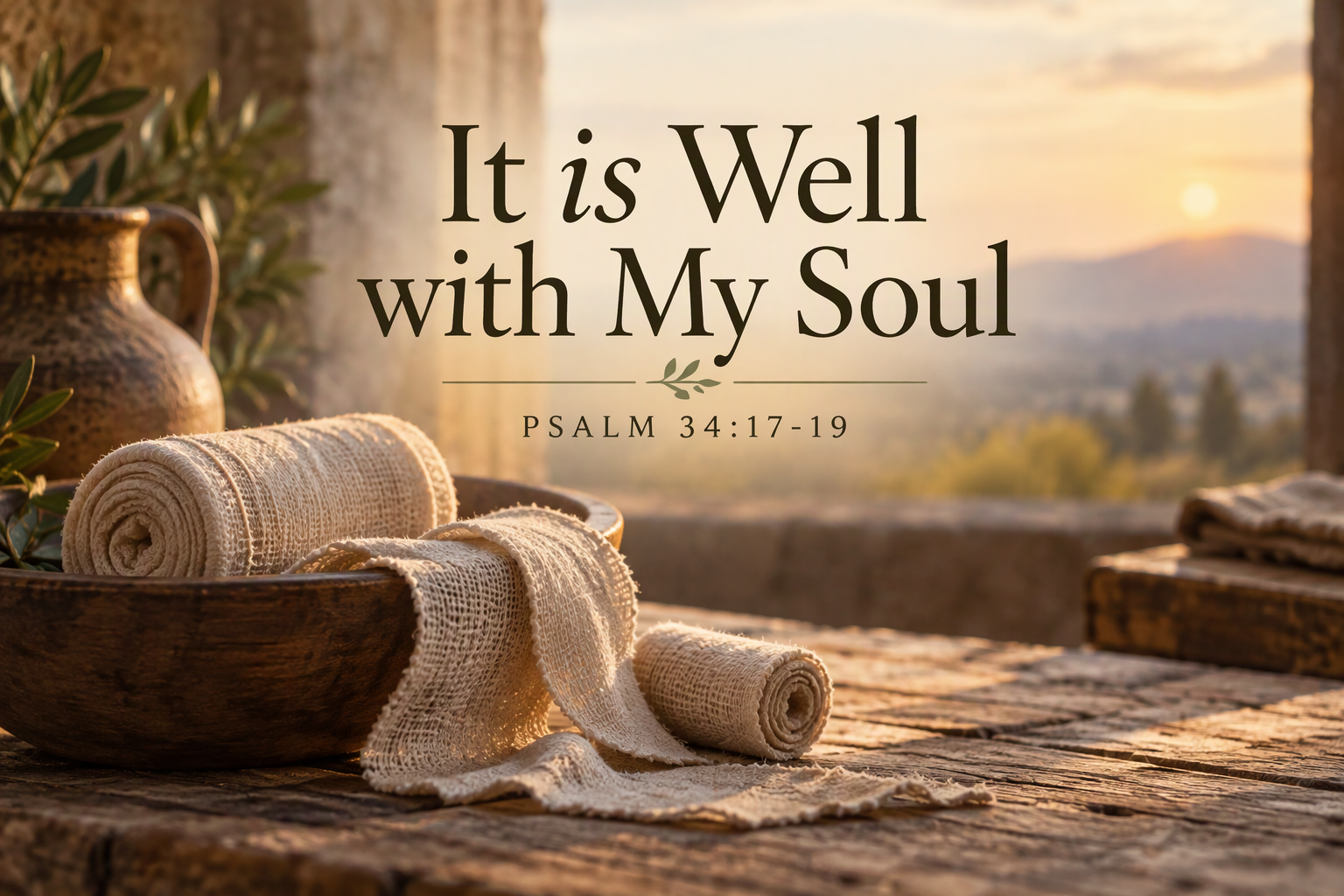
Psalm 34:17-19
"When the righteous cry for help, the Lord hears and delivers them out of all their troubles. The Lord is near to the brokenhearted and saves the crushed in spirit. Many are the afflictions of the righteous, but the Lord delivers him out of them all."
Most of us can look back on seasons of life when the words of Psalm 34 described our own experience. We know what it is to cry out for help, to carry burdens that seem overwhelming, and to feel, in David's language, "brokenhearted" and "crushed in spirit." These are not the words of a man unfamiliar with suffering. David knew trouble, fear, loneliness, and deep distress. Yet what stands out in this psalm is not merely the reality of affliction but the certainty of God's response. The Lord hears, He is near, and He surely delivers. For all who belong to Him, suffering is real, but so is the presence of God in the midst of it.
Notice that this psalm does not tell the brokenhearted to hurry up, nor does it suggest that a crushed spirit is a failure of faith. Instead, the passage opens with the righteous crying out for help and the Lord hearing their cries. Faith is not the absence of lament; it is what drives us to call upon God in the midst of our distress. The Psalms are full of laments because our God is not indifferent to our pain. In His wisdom and compassion, He has given us words to pray when grief, confusion, and sorrow seem too heavy to bear.
David knew what it was to flee, to hide, and to wrestle through seasons when God's face seemed hidden. Rather than hiding his pain, he poured out his heart before the Lord, and the Spirit preserved those prayers for God's people. Through them, we are reminded that faith is not the absence of sorrow but the willingness to bring our sorrow to God.
Verse 19 speaks with refreshing honesty: “Many are the afflictions of the righteous.” Not few, but many. Scripture never promises God's people a life free from pain. In this fallen world, sorrow, suffering, and hardship are realities we all face. Yet God's promise is not that we will avoid affliction, but that He will meet us in it. He hears the cries of His people, draws near to the brokenhearted, and sustains those who trust in Him. One day, Christ will return, and He will wipe away every tear from our eyes. Death shall be no more, neither shall there be mourning, nor crying, nor pain anymore (Rev. 21:4). But until that glorious day, we are not left to endure alone. The Lord is near.
Perhaps you have been walking a long road, through years of illness, a fractured family, a prayer that has gone unanswered for a decade, or a loss whose ache has never fully faded. For you, the word "deliverance" may feel like a rumor from a distant country. Hold on to the whole verse, because it says the Lord delivers "him out of them all." Theologians speak of the "already" and the "not yet," and this is where it matters. Full deliverance is still to come, but God's care for His people is not delayed until that day. Even now, He sees every tear, knows your mourning, and understands every ache of your heart. The God who promises to bring you safely home is already holding you fast along the way.
So, here is a small step for today. Say plainly to the Lord what you know to be true from His word. "Lord, I am crushed, but you are near to the brokenhearted, and will surely deliver me from all my afflictions."
He Binds Up Our Wounds
Another psalmist bears witness to this same truth in Psalm 147: "He heals the brokenhearted and binds up their wounds" (Ps. 147:3). Though we do not know the author's name, we know that he understood something of our sorrow. More importantly, he attests that the God who draws near is also the God who tends. He uses the language of a physician, or perhaps a shepherd kneeling beside an injured lamb. The language is tender and personal. The Lord does not merely acknowledge our wounds; He ministers to them, healing the brokenhearted and binding up what has been broken.
Think for a moment about how a serious wound actually heals. A broken bone is not mended in a day. It is set, and then it is bound in a cast, often for weeks. The limb is stiff and weak, and pain is not removed by the cast. The person wearing the cast may feel that nothing is happening. But beneath the plaster, quiet and unseen work is going on. The binding is not to replace the healing, but is protecting and sustain until healing is complete.
Hold that picture beside this verse. If your grief is fresh, you may feel that you ought to be doing something, getting past something, or at least functioning. But His presence is sustaining while true healing takes time. Some days the only task is to be held still, bound up in his care, and to trust the Great Physician.
And if you are years into your sorrow, hear this: he has not grown tired of you. Human patience wears thin. Friends who were faithful in the first weeks gradually return to their own lives, and we do not blame them, but we feel it. The Lord doesn’t work that way. "He heals" is a present, continuing action. The one who counts the stars and calls them by name (Psalm 147:4) has not lost count of your tears, and he has not run out of patience in your time of healing. The same chapter says that "his understanding is beyond measure" (Psalm 147:5). That includes the part of your pain that you cannot explain to anyone else.
Some wounds, we should say honestly, leave scars and a limp in this life. The gospel doesn’t deny that. But a scar is the mark of a wound that has been bound and closed, and the physician who tends you is the same one who will one day make all things new.
For today, let the verse be your quiet companion. Say it slowly: "He heals the brokenhearted and binds up their wounds." Present tense, patient hands, and no deadline.
It Is Well with My Soul
Many of us know the hymn “It Is Well with My Soul”. Its author, Horatio Spafford, wrote those beloved words out of profound grief. In 1873, after suffering significant financial losses, Spafford sent his wife and four daughters ahead of him on a voyage to Europe while he remained behind on business. During the crossing, their ship collided with another vessel and sank. His wife survived, but all four of their daughters were lost at sea.
As Spafford traveled to join his grieving wife, the ship carrying him crossed near the waters where his daughters had tragically perished. It was there, according to the commonly told account, that he penned the words that have comforted generations of Christians facing sorrow and loss:
"When peace like a river attendeth my way,
When sorrows like sea billows roll;
Whatever my lot, Thou hast taught me to say,
It is well, it is well with my soul."
Look closely at the lines. Peace and sorrow sit side by side in the same stanza. The river and the billows are both present. Spafford does not pretend the waves are not rolling. He says that in the midst of them, God has taught him to say something. The language is that of a lesson learned slowly, not a feeling that arrived automatically.
“It is well with my soul" is a resolute confession, not a feeling that came naturally. Saying "it is well" does not mean the loss is well, that the wound is small, or that your hurt is gone. It is a hard-won statement about where your soul is anchored, spoken by someone who is still surveying the loss.
So, where did Spafford find that anchor? Not in his feelings. He found it at the cross. The third stanza turns us there:
"My sin, oh, the bliss of this glorious thought,
My sin, not in part but the whole,
Is nailed to the cross, and I bear it no more;
Praise the Lord, praise the Lord, O my soul!"
In our darkest hour, our stability comes not from comprehending our circumstances, but from Christ who has dealt fully with sin, guilt, and condemnation. Christ has reversed the effects of the curse and is making all things new. If that is settled, then even our worst night cannot undo our standing in Him. The sea may roll, but our anchor will hold us fast.
If God Is For Us
Paul offers one final word of comfort in Romans 8: "If God is for us, who can be against us?" (Rom. 8:31). When suffering comes, our hearts are often filled with questions, but Paul directs us away from ourselves and back to the cross. How do we know that God is for us? Because: "He who did not spare his own Son but gave him up for us all." God has already demonstrated the depth of His love. The cross is God's unchanging answer to every doubt about His care.
Paul goes on to ask, "Who shall bring any charge against God's elect? It is God who justifies" (Rom. 8:33). For those who are in Christ, the final verdict has already been spoken. No accusation, no failure, no regret, and no sorrow can overturn what God has declared. And even now, Christ Himself intercedes for His people.
This is why David could say that the Lord is near to the brokenhearted. This is why the psalmist could say that He heals the brokenhearted and binds up their wounds. This is why Horatio Spafford, standing in the shadow of immense loss, could confess, "It is well with my soul." Their hope was not found in an absence of suffering but in the presence of a faithful God.
If your grief or suffering is fresh, bring it to Him. If your sorrow has stretched on for years, bring it to Him still. The Lord who hears is near. The Lord who has bound up your wounds will not forget you. He who raised Christ from the dead is making all things new. And the Lord who promises final deliverance will surely keep His word. Until that day, He holds His people fast. And because He is with us, we may say, even through tears, "It is well with my soul." For the Lord is near to the brokenhearted and will surely deliver His people from all their afflictions.
With love in Christ,
Pastor Chris
Subscribe to my email list
Subscribe to receive weekly devotions, theological reflections, and resources that deepen your walk with Christ.
Thank you for subscribing!
Have a great day!