Set the Scales Aside
Leviticus 19:35-36
You shall do no wrong in judgment, in measures of length or weight or quantity. You shall have just balances, just weights, a just ephah, and a just hin: I am the LORD your God, who brought you out of the land of Egypt.
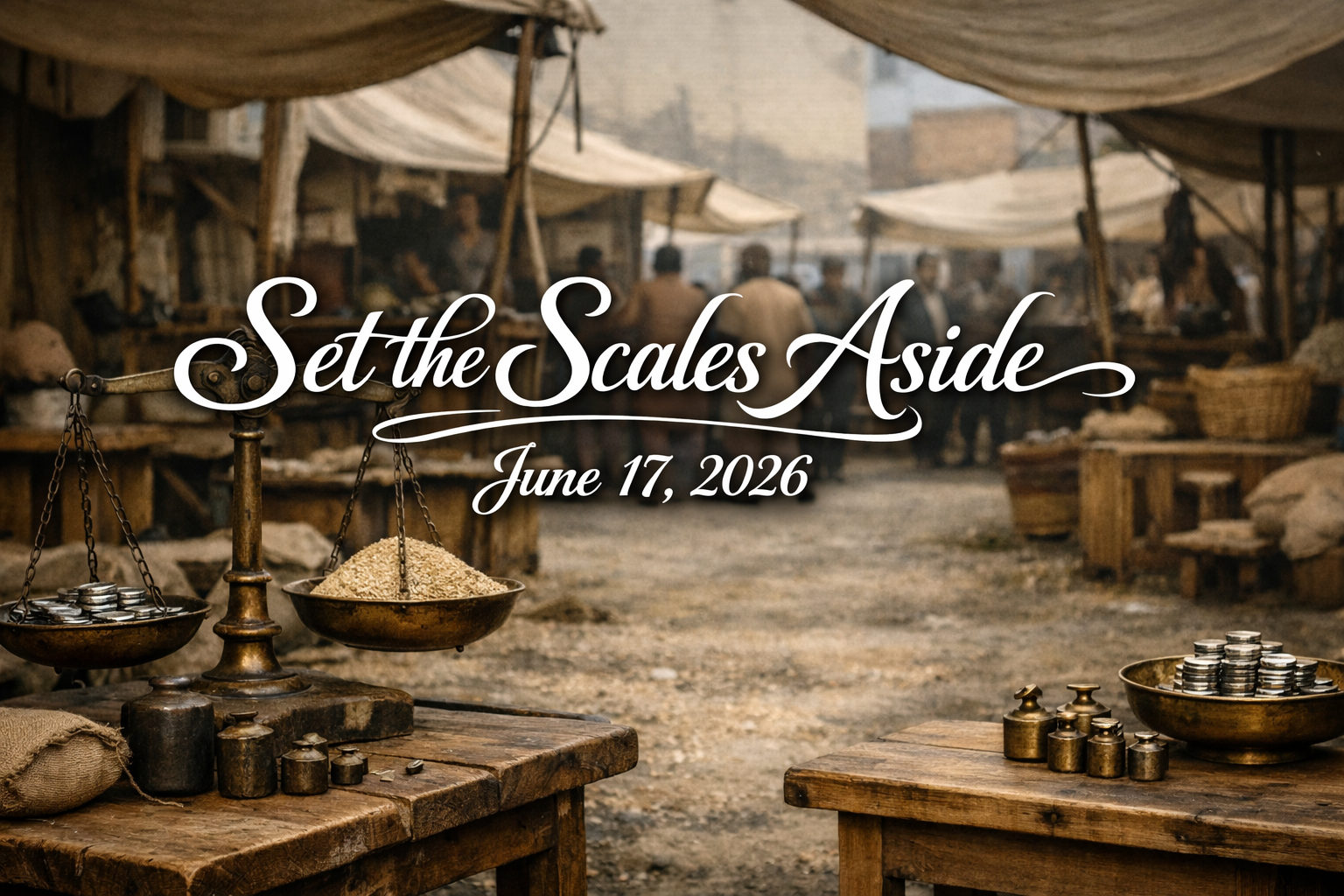
When God commands just balances, He means exactly what He says. Don't rig the scales. Don't shrink the measure of what you sell while inflating the price you charge. Don't cheat people. The marketplace is a moral space and God is watching what happens there.
The prophet Amos catches the merchants of the Northern Kingdom doing precisely this — scheming through every holy day about how to get back to their crooked scales, making the ephah small and the shekel great. What makes it particularly painful is that these are Jacob's descendants. Their patriarch had suffered this exact sin under Laban. Laban notoriously delivered the wrong daughter to Jacob for marriage and changed his wages ten times — systematically shifting the scales in his own favor year after year. And yet centuries later, Jacob’s children had become no better than Laban.
We are right to apply this command to our business practices — not overcharging for goods or underdelivering on promises — but the text reaches far beyond the marketplace. Whenever we evaluate our conflicts, consider someone’s failure, or assess another’s sin, we’re reaching for a set of scales. And the God who forbids dishonest scales in commerce also forbids the same in how we measure one another. That is the direction we draw from the passage today.
A Humbling Parable
Jesus illustrates this with overwhelming clarity in Matthew 18. A king settles accounts with his servants, and one man is brought before him who owes ten thousand talents — an almost comically astronomical sum. No laborer could earn that in a thousand lifetimes. There is no human effort that could pay it back. The servant falls on his face, begs for patience, and the king, moved with compassion, does something far better than granting patience — he cancels the debt entirely. Every last talent. Gone!
But that same servant who walks out of the throne room debt free, finds a fellow servant who owes him a hundred denarii — a few months' wages — and seizes him by the throat. "Pay what you owe." The fellow servant falls on his face, uses the exact same words, begs for the exact same patience, but receives neither mercy nor patience from the unforgiving servant.
The contrast is almost absurd. We almost laugh at it — until we recognize ourselves in it. The servant who had been forgiven an ocean of debt could not extend a cup of grace to his neighbor. He had uneven scales. He measured his own debt with one standard and his neighbor's debt with another. The king's fury in verse 34 is not a footnote. He retracts his mercy and commits the unforgiving servant to prison just as he had done to his debtor. It is a warning. The parable was an echo of the same warning Jesus gave in the sermon on the mount, “For with the judgment you pronounce you will be judged, and with the measure you use it will be measured to you.”
Examine Your Scales
We can keep fair balances in our commerce while missing the subtle ways we deceitfully measure others against an inflated opinion of ourselves. We excuse our own coldness as being busy while interpreting other’s coldness as rudeness. We do it with our children when we respond in anger toward their disobedience, failing to remember the patience our Heavenly Father has for ours. We do it with coworkers when our mistakes are explainable circumstances, but theirs are revealing patterns. When we shortchange the measure of our own sin, other people’s sins will always appear to outweigh ours.
But if there is one arena where unjust scales do the most damage, quietly and persistently over time, it is marriage. Marriage is the one relationship where we are close enough to see everything — every flaw, every repeated failure, every unkind word — and where our own pride has the most to protect. The temptation in marriage can be most persistent: to minimize what we contribute to a conflict while keeping careful and meticulous accounts of what our spouse has done. We remember their failures in high definition while we remember our own in soft focus.
This is not merely a relational problem. It is a spiritual one. The LORD who bore our sin on the cross is not unaware of the scales we carry into our closest relationships. He commands just balances because He is deeply invested in our marriages and families. Just measures are an act of love. Crooked scales are a form of theft, and we are stealing from our spouse, our children, and our neighbor, the honest accounting they deserve from us. The gospel will not let us stay comfortable here. The same God who forgave ten thousand talents is watching what we do with a hundred denarii.
The Glory of Setting the Scales Aside
Proverbs 19:11 says, "Good sense makes one slow to anger, and it is his glory to overlook an offense." Notice the word glory. Overlooking an offense is not weakness. It is the mark of a person who has enough wisdom, enough security, and enough gospel-saturated perspective to absorb a wrong without demanding repayment.
Proverbs twenty and verse 3 puts the contrast plainly: "It is an honor for a man to keep aloof from strife, but every fool will be quarreling." The fool here is simply someone who has an inability to forgive. The scales are always out. The ledger is always open. The person who insists on perfect accounts often ends up with a struggling marriage, damaged friendships, and resentful children.
I once received counsel that still echoes in my mind, and it fits today’s topic quite well. During a difficult season where I was being unfairly treated by a relative, a counselor told me, “You will have many opportunities to be offended. You have to choose not to be offended.” It isn’t a direct quotation from Scripture, but you can see its truth in Jesus Himself.
Jesus, hanging on the cross — having been betrayed, falsely accused, mocked, beaten, and nailed to wood by the very creatures He had made — cries out in the presence of His executioners, "Father, forgive them, for they know not what they do." He didn’t reach for the scales. He reached for grace. He had more right than anyone to demand a perfect accounting of sins, yet he set the scales aside entirely. That is the standard toward which to direct our aim. That is the glory. And by His grace alone, it is the life we are being conformed into.
With love in Christ,
Pastor Chris
|
Reflection Questions |
|---|
|
Where in your life are you tempted to “rig the scales” — to present yourself more favorably than truth allows? |
|
Understanding that God has sanctified you over time, have you rightly formed an opinion of someone in the past that is now unfair to maintain? |
|
What practical step can you take to ensure your evaluations — of people, motives, or conflicts — reflect God’s justice and compassion? |
Sign up to receive emails like this each week.
Thank you for subscribing!
Have a great day!