The Bread of Life
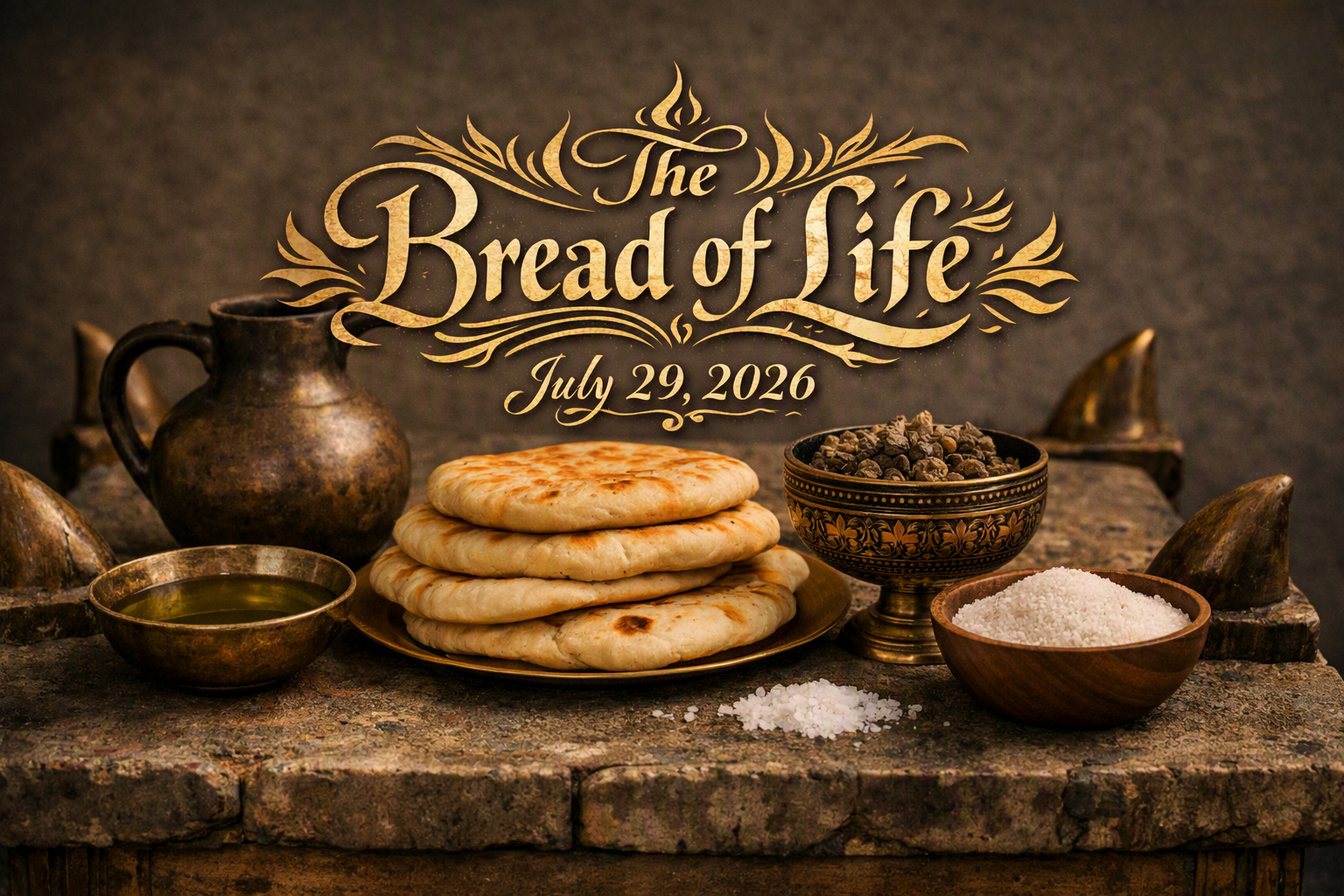
Leviticus 2:1-3
“When anyone brings a grain offering as an offering to the LORD, his offering shall be of fine flour. He shall pour oil on it and put frankincense on it and bring it to Aaron's sons the priests. And he shall take from it a handful of the fine flour and oil, with all of its frankincense, and the priest shall burn this as its memorial portion on the altar, a food offering with a pleasing aroma to the LORD. But the rest of the grain offering shall be for Aaron and his sons; it is a most holy part of the LORD's food offerings.”
Setting the Scene: A Priest in the Temple Courts
Imagine, for a moment, that you are standing barefoot on packed earth, the sun just breaking over the eastern gate of the temple. Smoke curls upward from the bronze altar, thick and grey, carrying with it the scent of burnt meat and, mingled in it, something sweeter — a trace of frankincense drifting on the morning air. You’re a priest in the Jerusalem Temple and this is an ordinary day.
Leviticus 1 through 7 meticulously and repetitively lays out for you five distinct offerings that structure your entire vocational life: the burnt offering, wholly consumed for atonement and consecration; the grain offering, a tribute of thanksgiving; the peace offering, shared in fellowship; the sin offering, dealing with unintentional transgression; and the guilt offering, addressing sins requiring restitution. Four of these five involve blood. One does not.
That one — the grain offering of Leviticus 2 — is where we direct our attention today. It is easy to skip past. There is no slaughter here, no dramatic scene of a knife and an altar. And yet the writer of Hebrews will not let us treat any part of this tabernacle furniture as incidental, for "the law has but a shadow of the good things to come" (Hebrews 10:1). The flour and oil, frankincense and salt, are shadows with substance behind them that resonate through the four Gospels. Let us read what the Lord commanded and see what — or rather who — stands behind the shadow.
Leviticus 2:1-3 reads: "When anyone brings a grain offering to the Lord, his offering shall be of fine flour. He shall pour oil on it and put frankincense on it and bring it to Aaron's sons the priests. And he shall take from it a handful of the fine flour and oil, with all of its frankincense, and the priest shall burn this as a memorial portion on the altar, a food offering with a pleasing aroma to the Lord. And the rest of the grain offering shall be for Aaron and his sons; it is a most holy part of the Lord's food offerings."
Later in the chapter the Lord adds a further stipulation: "When you bring a grain offering baked in the oven as an offering, it shall be unleavened loaves of fine flour mixed with oil or unleavened wafers smeared with oil.”
Flour, Oil, Salt and Fire
The ordinary Israelite’s worship of bringing a baked grain offering, began at home by first clearing away every trace of leaven from their presence. Only then would they bring out their flour—fine flour—carefully sifted to remove husk and impurity, worked until nothing coarse remained, ready to be worked into the unleavened bread for the offering.
Throughout Scripture, leaven often symbolizes corruption—quiet, subtle, and pervasive. Jesus warned His disciples, “Watch and beware of the leaven of the Pharisees and Sadducees” (Matthew 16:6), and the Gospel writer explains that He was speaking not of bread, but of their teaching. Paul reaches for the same image when he reminds the Corinthians that “a little leaven leavens the whole lump” (1 Corinthians 5:6). So, each time an Israelite thoroughly cleansed leaven from the home and carefully sifted flour to remove every impurity, the act became a quiet foreshadowing of Christ’s sinless humanity—wholly free from the leaven of sin.
But flour alone was never the offering. “He shall pour oil on it,” verse 1 says. The worshiper tipped the vessel of olive oil so it ran down into the flour and worked beneath their fingers. Olive oil carried its own rich symbolism. The finest olives were hand‑picked from groves surrounding Jerusalem, including gardens like Gethsemane, sorted to remove leaves and twigs, washed clean of dust, then crushed beneath the millstone into a thick paste. The paste was pressed again and again, though only the first, purest press was fit for the Temple. You’re right to picture our Lord praying in Gethsemane on that final Passover, agonizing under the weight of our guilt, with his sweat becoming like great drops of blood falling to the ground.
Olive oil in the tabernacle served many sacred purposes. It fueled the lampstand in the Holy Place, a sign of the light of God’s presence in the world. It anointed priests and kings, poured over their heads as the visible emblem of the Spirit’s presence and power (1 Samuel 16:13). Together, flour and oil form a rich portrait of the Messiah—the Anointed One—upon whom the Spirit descended “not by measure” (John 3:34).
Then, the worshiper reaches for one more ingredient, tucked away in verse 13: "You shall season all your grain offerings with salt... you shall not let the salt of the covenant with your God be missing." You work it into the cakes, a small grain carrying covenantal significance. Salt was the ancient preservative — the sign of something that would not spoil or decay. To call it "the salt of the covenant" ties this grain to God's own covenant faithfulness — a covenant made with David "a covenant of salt forever" (2 Chronicles 13:5).
Now, the moistened flour is mixed into cakes, for the law allows this offering to be baked in an oven, cooked on a griddle, or in a pan (Leviticus 2:4-7). Either way, fire is not optional — the offering must pass through heat before it is set before the Lord. The purity of the flour and the anointing of the oil were not, by themselves, the whole picture. The offering still had to be baked and purified. Like our Lord, though without sin, was still tested through various fiery trials. “For because he himself has suffered when tempted, he is able to help those who are being tempted” (Hebrews 2:18), and because of this we can endure our trials, “so that the tested genuineness of your faith—more precious than gold that perishes though it is tested by fire—may be found to result in praise and glory and honor at the revelation of Jesus Christ.”
Frankincense and Oil
With the cakes fully prepared, they would be broken and anointed with olive oil. The worshiper would then present the offering with frankincense to you, the priest. Then, taking possession of the offering, you place a portion of it upon the alter and watch it catch and rise as smoke, filling the air with a rich, distinctive fragrance. The text tells us why it matters: this smoke rises as "a pleasing aroma to the Lord" (v. 2) — technical language running throughout Leviticus for an offering fully acceptable, satisfying to God's own holiness.
Paul reaches directly for this image in Ephesians 5:2, describing Christ, who "gave himself up for us, a fragrant offering and sacrifice to God." The frankincense of Leviticus 2 finds its terminus not in temple incense but in the cross itself — the one offering that rose before the Father not merely as ritually correct, but as truly, finally pleasing. Where our best efforts remain mixed and partial, Christ's self-offering, having passed through the fire of judgment, rose before the Father wholly fragrant, wholly accepted.
So it was with our Lord. He was sinless like the fine flour, the Spirit rested on him just as the oil was poured out on the offering, he was tested by fiery trials just as the cakes were baked, and he was broken for us. And at the altar of the cross, the fire of God’s wrath fell. "It was the will of the Lord to crush him; he has put him to grief" (Isaiah 53:10). The wrath our sin deserved — the consuming heat of God's holiness against all that is false and leavened — fell instead on the one who had no leaven in him at all. The alter of Calvary was no accident; it was the Father's appointed wrath, and the Son willing bore it for us. This is the flour, the oil, and the fire together — these are the shadows, but the substance belongs to Christ.
The frankincense tells us the offering is accepted; the preserving covenantal salt tells us that acceptance will not expire. In Christ, our acceptance before God is not temporary, renewed and re-earned week by week. Hebrews 10:14 says it plainly: "For by a single offering he has perfected for all time those who are being sanctified." The fire has done its work. The salt has been added. The covenant does not decay.
The Priests' Portion
One final detail completes the picture. Only a “handful” of the offering was burned as the memorial portion on the altar (v. 2), while the rest—the far greater share—became your food, the priest’s portion: "for Aaron and his sons... a most holy part of the Lord's food offerings" (v. 3). Being priests, you did not merely transport it to the alter. You would take this bread and partake of it. It sustained you. It was, quite literally, your daily bread, set apart as holy, eaten in the courts of the Lord's own house.
Here the shadow reaches forward to touch us directly. To know Christ is not only to behold an offering made on our behalf at a safe distance. It is to draw us near into the presence of God, to feed on him. Jesus himself takes up exactly this language: "I am the bread of life... whoever feeds on me, he also will live because of me" (John 6:35, 57). And Paul, describing our fellowship at the Table, asks, "The bread that we break, is it not a participation in the body of Christ?" (1 Corinthians 10:16).
So, this small, easily overlooked offering — flour, oil, frankincense, salt — carries within it the whole shape of the gospel. The sinless Son, anointed by the Spirit, offered up as a pleasing and permanent sacrifice, and now given to his people as food — communion with the Father, restored and sustained, in him. The priest standing in the smoke that morning, raising the unleavened toward the altar, did not yet know whose face he was tracing in flour and oil. We do. And so, this morning, we do not merely study an ancient ritual — we behold, once more, the Bread of Life himself, given for us, and given to us.
With love in Christ,
Pastor Chris
Reflection Questions
|
1. In what ways does seeing Christ in Leviticus deepen my trust that Scripture is not a collection of disconnected religious writings, but a single, Spirit breathed story pointing to one Savior from beginning to end? |
|
2. What other scriptures came to mind as you read about the symbolisms in this devotion? |
|
3. If every grain offering required “the salt of the covenant,” what does that reveal about God’s desire for permanence, purity, and faithfulness in His people — and how does that shape my understanding of Jesus calling me “the salt of the earth”? |
Sign-Up for weekly devotions!
Thank you for subscribing!
Have a great day!