The King is Reigning
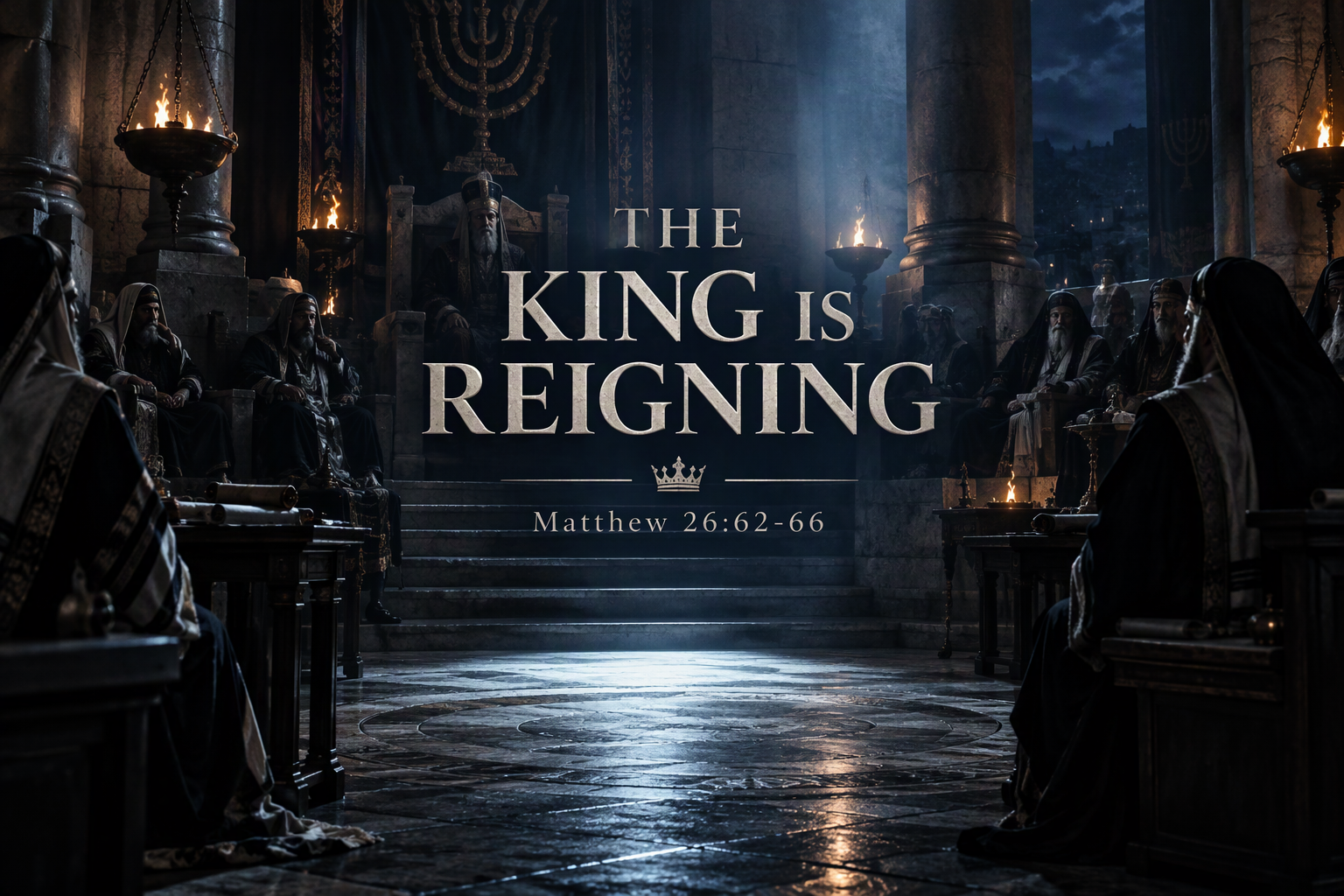
Matthew 26:62-66
And the high priest stood up and said, “Have you no answer to make? What is it that these men testify against you?”
But Jesus remained silent. And the high priest said to him, “I adjure you by the living God, tell us if you are the Christ, the Son of God.”
Jesus said to him, “You have said so. But I tell you, from now on you will see the Son of Man seated at the right hand of Power and coming on the clouds of heaven.”
Then the high priest tore his robes and said, “He has uttered blasphemy. What further witnesses do we need? You have now heard his blasphemy.
What is your judgment?” They answered, “He deserves death.”
Place yourself in the room that night. The hour is late. Lamps flicker against the walls of the high priest’s palace as the religious leaders gather to try Jesus. But something feels off from the very beginning. You realize justice has been turned upside down.
In a proper court, charges are always brought, evidence is examined, and then a verdict is rendered. Here, the verdict has already been decided. Caiaphas the high priest has previously decided Jesus must be condemned to death (John 18:14). But they have no such charge that will justify the sentence of death.
So, the search begins. Witness after witness is ushered forward. Accusations are offered. Testimony is heard. Yet every attempt unravels as the law has established that all accusations must be confirmed by two or three witnesses (Deuteronomy 19:15). Stories conflict. Claims collapse. The witnesses contradict one another. Again and again the prosecution reaches for evidence, and again and again it comes back empty.
The tension has grown in the room. The men assembled to condemn Jesus cannot even establish a single charge against him. The verdict is ready, but the evidence refuses to cooperate.
Finally, two witnesses come forward with a valid accusation: “This man said, ‘I am able to destroy the temple of God, and to rebuild it in three days.’” At last, it appears they may have found something. The high priest rises to his feet. His patience has worn thin and is met with a new posture. Turning toward Jesus, he demands, “Have you no answer to make? What is it that these men testify against you?”
Every eye in the room fixes on the prisoner, but Jesus says nothing.
The claim hangs in the air unanswered. The pressure mounts. Yet the Lamb remains silent. As Isaiah foretold, “like a sheep that before its shearers is silent, so he opened not his mouth.” The only truly innocent man in the room refuses to give a defense.
The high priest is getting nowhere. The witnesses have failed him. The accusations have failed him. The case itself has failed him. Again and again the court reaches for evidence, and again and again its hands come back empty.
If a conviction is going to be secured, Jesus himself will have to provide the charge.
So, Caiaphas changes course. He places Jesus under oath before the living God and asks, “I adjure you by the living God, tell us whether you are the Christ, the Son of God.”
This has not been an honest search for the truth, and this inquiry from Caiaphas is not honest either. The evidence concerning Jesus has been before Israel throughout the entirety of Christ’s ministry. Great miracles have been performed. The Scriptures have been taught. Yet the court has already chosen its verdict. He doesn’t ask this question because he’s willing to believe, but because they finally think they have found a charge worthy of the sentence they have already determined to impose. Since they’re unwilling to decently evaluate the evidence, an affirmation from Christ would be seen as blasphemy — sin worthy of death according to the law.
Jesus’ response, "You have said so", is an affirmation. Yes, he is the Christ, the Son of God. Then he does something remarkable. The prisoner turns the courtroom around. "But I tell you, from now on you will see the Son of Man seated at the right hand of Power and coming on the clouds of heaven." The one standing bound before the court says that the court itself will be standing before him from now on and will one day ultimately answer to him.
Here is what we must see. Jesus didn’t invent this title. "Son of Man" and "coming on the clouds of heaven" are not casual phrases. Every educated man in that room recognized the source at once. Jesus is quoting the prophet Daniel, and he is claiming that the vision Daniel saw was about himself. Bound and on trial, Jesus claims the throne of heaven. That is where we turn next.
The Vision Fulfilled
The prophet Daniel tells us of his vision, "I saw in the night visions, and behold, with the clouds of heaven there came one like a son of man, and he came to the Ancient of Days and was presented before him. And to him was given dominion and glory and a kingdom, that all peoples, nations, and languages should serve him; his dominion is an everlasting dominion, which shall not pass away, and his kingdom one that shall not be destroyed." (Daniel 7:13-14)
Notice the direction of travel in Daniel's vision. The Son of Man comes with the clouds, but he does not come down to earth. He comes to the Ancient of Days, to the throne of God. He is presented before the Father, and there he receives dominion, glory, and a kingdom. It is a coronation, and it takes place in heaven.
That matters for how we read Jesus' words before Caiaphas. He says, "from now on you will see." He does not say "someday, much later." From now on. The movement of Daniel 7 begins with the very events that this night sets in motion: the cross, the resurrection, and the ascension. The Son of Man goes to the Father, and he is enthroned. The courts of Jerusalem think they are deciding his fate. In reality they are setting the stage for his enthronement.
This is why the church has long confessed that Christ is seated at God's right hand. The Heidelberg Catechism asks what comfort there is in this, and the answer is that Christ is the head of his church, and that through him the Father governs all things (Q&A 50). Everything, from the throne rooms of empires to the smallest corner of your week, is governed by the Father through the Son.
Daniel's vision of the Son of Man coming on the clouds is not waiting on a future fulfillment. It has been inaugurated and decisively fulfilled in Christ's enthronement. The kingdom has been given, the dominion is his, and it will not pass away. So what does that mean for the world we live in today?
A Kingdom in Our Midst
If the Son of Man has received the kingdom, then the kingdom is not merely a distant hope. It is here, and the King himself is its center. Jesus told the Pharisees that the kingdom was already in their midst (Luke 17:21). He did not mean it was a program or a place on a map. He meant that the kingdom was already present because the King and his saving reign had come among them.
We see the kingdom breaking in all through the Gospels. When Jesus cast out demons by the Spirit of God, he declared it proof that the kingdom of God had come upon them (Matthew 12:28). Every exorcism was an announcement that a stronger man had entered the house, and the old tenant must be bound (Matthew 12:29).
And after the resurrection, the risen Christ told his disciples that all authority in heaven and on earth had been given to him (Matthew 28:18). Notice the tense. It has been given, already. This is Daniel’s vision (Daniel 7:14) in the language of the Gospels, the dominion given to the Son of Man now being announced to his people.
This is why we do not need to wait for an earthly kingdom that will finally begin at some future point. The kingdom is not on hold, but it was, and it is still now in our midst. The assembly of his people advances now, quietly, as the gospel goes out and sinners of all nations and peoples are brought out of darkness into his marvelous light. Like a seed, it grows, and it initially looks unimpressive compared to the empires of this world.
But it will not stay hidden. The same Jesus who spoke of "coming on the clouds" will return visibly, and that return will bring the kingdom to its completion. We live between the enthronement and the unveiling. The King reigns now, and he will appear then.
The question is, who are the people of this kingdom, and how are they to live while they wait?
Kingdom People Before Hostile Courts
Here is the part of Daniel 7 that we often skip. The Son of Man does not receive the kingdom alone. Later in the same chapter, the interpretation of the vision says that the saints of the Most High will receive the kingdom and possess it forever (Daniel 7:18), and that the kingdom and dominion will be given to the people of the saints of the Most High (Daniel 7:27). The King shares his reign with his people.
That is who we are. God has already delivered us from the domain of darkness and transferred us into the kingdom of his beloved Son (Colossians 1:13). Notice that this is a completed reality, not an advancement we are still waiting to receive. John tells us that Christ has made us a kingdom and that we serve as priests to his God and Father (Revelation 1:6). The Heidelberg Catechism says as much when it explains why we are called Christians: we share in Christ's anointing as prophet, priest, and king (Q&A 32).
So, we are kingdom people, but we do not yet look like it. Christ's kingdom is not of this world (John 18:36). In Caiaphas's courtroom, Jesus appeared weak, defeated, and powerless. By every earthly measure, he was the one on trial: bound, surrounded, and outnumbered. Yet beneath the surface, reality was the exact opposite. The prisoner was the Judge, the accused was the King, and the court itself stood under his authority.
In much the same way, the glory of Christ's kingdom is often hidden from human eyes. You may look like an ordinary believer going about an ordinary week. You work, pay bills, battle sin, endure disappointments, and face the same troubles as your neighbors. Yet by grace you belong to the Son of Man who has already received dominion, glory, and a kingdom. The world sees only an ordinary Christian. Heaven sees a citizen of an everlasting kingdom. What is hidden now will one day be revealed when the King who reigns today appears in glory.
And we stand where he stood. Maybe it is not a formal court. It may be a hostile workplace, a skeptical family, or a culture that finds our confession foolish. We may be mocked, questioned, or pressed to deny him. But we do not stand there awaiting a verdict. The Son of Man has received the kingdom, and we belong to him. We can speak honestly and without panic, because the outcome is not in doubt.
And we wait for the King who is coming. The Jesus who told the high priest, "you will see," has indeed been seen since that day by those with eyes to see. Jerusalem and the Temple fell just as he foretold. The gospel has flourished, and people from the nations have come to know and serve him. And he is returning for his people. Until then, we stand, speak, and serve as those who belong to his kingdom.
With love in Christ,
Pastor Chris
Subscribe to my email list
Subscribe to receive weekly devotions, theological reflections, and resources that deepen your walk with Christ.
Thank you for subscribing!
Have a great day!