The Spring Beneath Our Effort
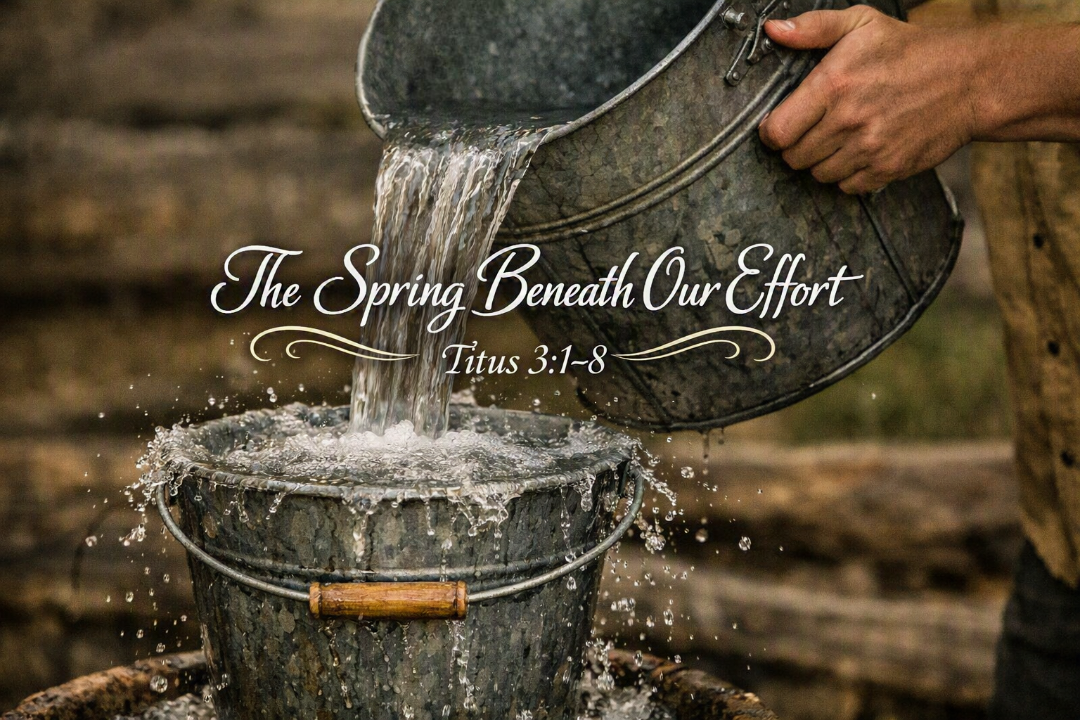
Titus 3:1-7
“Remind them to be submissive to rulers and authorities, to be obedient, to be ready for every good work, to speak evil of no one, to avoid quarreling, to be gentle, and to show perfect courtesy toward all people.
For we ourselves were once foolish, disobedient, led astray, slaves to various passions and pleasures, passing our days in malice and envy, hated by others and hating one another. But when the goodness and loving kindness of God our Savior appeared, he saved us, not because of works done by us in righteousness, but according to his own mercy, by the washing of regeneration and renewal of the Holy Spirit, whom he poured out on us richly through Jesus Christ our Savior, so that being justified by his grace we might become heirs according to the hope of eternal life.
The saying is trustworthy, and I want you to insist on these things, so that those who have believed in God may be careful to devote themselves to good works. These things are excellent and profitable for people.”
The Dry Well
Picture an old well on a farm during a long drought. The bucket still hangs on its rope. The crank still turns. But when you lower that bucket down and pull it back up, it comes back empty—or worse, full of mud and dust. The problem is never with the bucket. The problem is with the source of the well. Somewhere down below, the water table itself has dropped and the well has dried up. And until the spring is replenished, no amount of cranking, effort, or technique is going to produce water.
This is the condition Scripture says we inhabit as humans in our flesh. We do not merely need better habits, stronger resolve, or more moral effort. Our problem is deeper: the source of righteousness itself is missing. Paul makes this diagnosis in his letter to Titus. The churches on Crete were surrounded by a culture he describes—quoting one of their own poets—as “liars, evil beasts, lazy gluttons” (1:12). But Paul does not respond to Crete’s moral drought by demanding more willpower or by urging them to crank the handle harder. He goes underground. He goes to the source. And that is where Titus 3 takes us: to the reality that humanity’s well has run dry, and only God can replenish the spring.
Renewed by Mercy, Not Merit
Paul opens this passage by laying out a straightforward call to obedience: submit to rulers and authorities, be obedient, be ready for every good work, speak evil of no one, avoid quarreling, be gentle, and show perfect courtesy toward all people (vv. 1–2). At first glance, it feels almost like a standard workplace code of conduct—something you might see posted in a break room. In other words, Paul is pointing us toward virtues our broader culture already applauds. Even those with no religious commitments would agree these are good, admirable qualities worth pursuing.
But then, in verse 3, Paul does something remarkable. He turns the mirror around with even himself in view. "For we ourselves were once foolish, disobedient, led astray, slaves to various passions and pleasures, passing our days in malice and envy, hated by others and hating one another." He doesn’t say they—as though this were merely a critique of Cretan culture or pagan Gentile behavior. He says we, deliberately including himself, the gentile Titus, the Jewish believers, and every reader since. Paul refuses to let anyone imagine they exist outside of this brokenness; he insists that Jews and Gentiles alike shared the same enslaved, self‑destructive condition apart from grace.
And this matters deeply for how we think about good works. If verse 3 is true—if we really were all spiritually adrift and unable to produce the life God calls for—then the commanded effort toward the virtues in his opening charge cannot possibly be the remedy for our condition. You cannot revive a dry well by commanding it to produce water. Paul knows this, which is why verse 4 turns with a hope‑filled conjunction: “But when the goodness and loving kindness of God our Savior appeared, he saved us—not because of works done by us in righteousness, but according to his own mercy, by the washing of regeneration and renewal of the Holy Spirit” (vv. 4–5). Paul has charged us to live righteously (vv.1-2), he has exposed our past inability to do so (v. 3), and now he shows us that God Himself has supplied the very means by which righteousness becomes possible (vv. 4-7).
Let’s closely examine three phrases in this passage. First: “not because of works done by us in righteousness.” Paul is deliberately slowing us down here. He wants us to feel the weight of it—to let it dismantle any lingering instinct to credit ourselves for what only God could do. Paul is explicit—almost redundantly explicit, for anyone tempted to smuggle their own merit in through the back door. Salvation is the act of God reaching down into a well that had gone bone dry and replenishing the spring itself.
Second, Paul shows that the mercy of God has supplied exactly what our deprived state could never produce: “the washing of regeneration.” This is new‑birth language—the announcement of a fundamentally new beginning. Paul’s first readers would have immediately heard the echo of their own baptism in those words, the moment they were visibly marked as belonging to Christ and filled with His Spirit. It is clear from Paul’s other writings that baptism functions as a visible sign of our real participation in the death, burial, and resurrection of Christ (Romans 6:3-4).
And Paul is not inventing this theology out of thin air. He is, almost certainly, drawing on Ezekiel 36 (vv. 25-27), where God promises his exiled people: "I will sprinkle clean water on you, and you shall be clean... And I will give you a new heart... And I will put my Spirit within you, and cause you to walk in my statutes." Look at the categories: cleansing water, a new heart—regeneration—and the indwelling Spirit producing obedience. That is Titus 3 (vv. 4-5), five centuries early. Ezekiel even places obedience last, as the consequence of the new heart and Spirit, not the cause of it—the same order Paul insists on. Paul, well-trained in these Scriptures, is not grafting a New Testament innovation onto an Old Testament religion of works. He is announcing that Ezekiel's ancient promise has finally arrived in Christ. This has always been God's plan—one covenant of grace, unfolding across the whole of Scripture.
Finally, "Renewal of the Holy Spirit"—that is the language of ongoing, continual replenishment. This is not a onetime patch job. This is God going underground, to the source, and doing what no amount of moral effort from verses 1-2 could ever accomplish. We’re not growing in good works because we finally worked hard enough or cranked the handle long enough, but because the Spring himself came down—washing us in the bath of regeneration and renewing us by the Holy Spirit. This is what causes us to walk in His ways.
The Spring Overflows
But here is what I love about Paul—he never leaves renewal stranded in the abstract. Verse 6 tells us that God "poured out" this Spirit on us "richly through Jesus Christ our Savior." That is not a trickle. That is not our Lord grudgingly yielding half a bucket. That is a spring so replenished it overflows.
And overflow toward what end? Verse 8: "so that those who have believed in God may be careful to devote themselves to good works. These things are excellent and profitable for people." There it is—the good works of his opening charge return, but now they arrive in an entirely different order. They are not the cause of renewal; they are the result of it. They are not the bucket straining to produce water from an empty well; they are water finally, naturally, overflowing from a spring that has been replenished by the Holy Spirit.
As you step back from Titus 3, remember this: God truly calls you to live a holy, obedient, gentle, Christ‑shaped life. The exhortations to devote ourselves to righteousness are not optional—they are the everyday shape of a life that reflects the goodness of our Savior. But here is the beauty of the gospel: God is not commanding the empty vessels we once were to produce righteousness by our own power. He has supplied you with the very means to live justly. The Spring beneath your effort has been replenished. The Spirit has been poured out richly. The well is no longer dry.
This means holiness becomes deeply practical. Tomorrow, when patience or gentleness rises in you, pause long enough to recognize that this is the Spirit’s work—not your old well suddenly producing water—and thank God for what He is doing in you. And when you resist the urge to speak evil of someone, acknowledge that this restraint is evidence of His renewal, and praise Him for supplying what He commands. Embrace the truth that God Himself is the One who “causes you to walk in His statutes,” and celebrate even the smallest steps of grace‑empowered faithfulness. Holiness is not a ladder you climb; it’s the quiet, steady work He is already doing within you, showing itself one Spirit‑enabled act of obedience at a time.
So, devote yourself to good works—not to earn God’s favor, but because His favor has already remade you. Let the Spirit’s renewal overflow into your home, your workplace, your conversations, your reactions, and even your habits. God’s call to holiness is real, but so is His provision. The One who commands the walk has already supplied the strength. And as you draw from the Spring beneath your effort, you will find that His grace is more than enough for every step ahead.
With love in Christ,
Pastor Chris
Subscribe to my email list
Subscribe to receive weekly devotions, theological reflections, and resources that deepen your walk with Christ.
Thank you for subscribing!
Have a great day!